
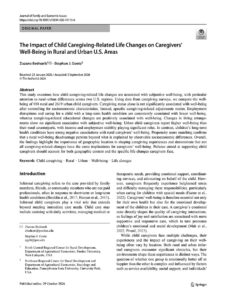
The Impact of Child Caregiving-Related Life Changes on Caregivers’ Well-Being in Rural and Urban U.S. Areas, https://doi.org/10.1007/s10834-026-10115-6
A new, open-access paper, recently published in the Journal of Family and Economic Issues, shares the results of a study exploring how child caregiving-related life changes are associated with subjective well-being, with particular attention to rural–urban differences across two U.S. regions.
In the paper, co-authors Zuzana Bednarik, North Central Regional Center for Rural Development and Stephan Goetz, Northeast Regional Center for Rural Development use data from two identical regional caregiving surveys conducted in the North Central and Northeast Regions in the U.S. — the NCR-Stat: Caregiving Survey and the NER-Stat: Caregiving Survey. First, the authors use the data to examine the association between child health conditions and caregivers’ subjective well-being and then extend the analysis to incorporate caregiving-related life changes, including changes in living arrangements, employment, and education, to assess whether these changes are associated with caregivers’ well-being. Finally, the authors estimate models that additionally account for caregivers’ socioeconomic characteristics and compare separate estimations for rural and urban child caregivers.
Access and download the journal article
# # #
The North Central Regional Center for Rural Development (NCRCRD) is one of four Regional Rural Development Centers in the United States. NCRCRD’s work links the research and educational outreach capacity of our region’s 34 land-grant universities with rural communities to help address a wide range of development issues unique to our 12-state region.
The Center’s work is supported by the USDA National Institute of Food and Agriculture. Any opinions, findings, conclusions, or recommendations expressed in this publication are those of the author(s) and should not be construed to represent any official USDA or U.S. Government determination or policy.