
By Renee Wiatt, Research and Extension Specialist, NCRCRD and Purdue Institute for Family Business
Every farm family eventually asks the same question: Who will fill my shoes? It’s a question about land, but it is also a question about people. The succession question is about roles, relationships, and the quiet expectations that shape whether a transition succeeds or stalls. That question was at the center of this year’s International Farm Transition Network (IFTN) Annual Professional Development Conference, held June 2–3, 2026 in Gettysburg, Pennsylvania, which I attended and had the honor of presenting.
Beyond Assets: Roles, Relationships, and Family Dynamics in Farm Transition
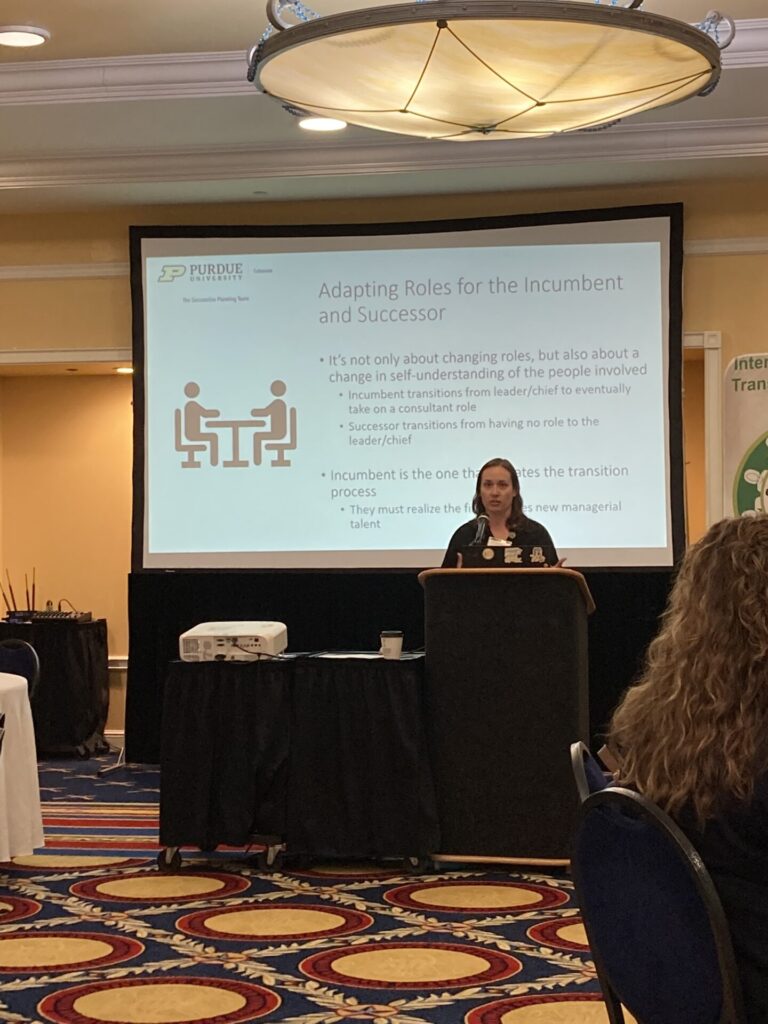
Renee Wiatt presenting at the IFTN Conference, June 2-3, 2026.
INTF’s conference theme this year, Beyond Assets: Roles, Relationships, and Family Dynamics in Farm Transition, pushed past the technical aspects of succession including the entity structures, the buy-sell agreements, and the legal instruments to focus on something harder to standardize — how families actually navigate the human side of transferring a farm. Sessions at the conference explored how labor, authority, and identity shift across generations, and how deeply those shifts are shaped by long-standing family norms, communication patterns, and emotional attachment to land and legacy. My presentation, Roadmapping Your Farm’s Transition, shared a resource that coordinators can use to help farm families plan for transition.
For those of us who spend at least portions of our working days facilitating succession conversations, this framing matters. It is easy to hand a family a checklist of legal steps. However, it is much harder and much more valuable to help farm families talk honestly about gendered expectations, uneven participation in decision-making, and the intergenerational negotiation that determines whether a plan is implemented. IFTN’s conference created space for exactly that kind of conversation among practitioners, researchers, and Extension professionals from across the world.
Becoming a Certified Farm Succession Coordinator
Attending this year’s conference had extra meaning for me because of a milestone I reached in fall 2025: completing IFTN’s Certified Farm Succession Coordinator training. The certification is a 20-hour program, delivered over two and a half days, designed for professionals such as Extension educators, attorneys, accountants, financial advisors, ag lenders, and farm family consultants among them. This certification is for individuals who work directly with farm families on succession. The training goes beyond legal and financial mechanics to build the facilitation and communication skills needed to guide families through the full scope of a transition: the transfer of labor, skills, and decision-making authority. The training also enhances the trainee’s knowledge of how to handle communication and bias that they have as coordinators as well as with the families that they serve.
Earning that certification gave me a stronger toolkit for the facilitation work I already do through the Purdue Institute for Family Business, and it connected me to IFTN’s broader community of certified coordinators well before I ever set foot in Gettysburg. Attending the 2026 conference as a certified coordinator felt like a natural next step and a chance to network with peers who do this work every day.
Why IFTN Matters to the NCRCRD
IFTN exists to support a network of certified farm succession coordinators and to advance the practice of facilitated farm transition planning. That mission overlaps closely with a collaboration I have been part of for several years — the Who Will Fill My Shoes: Succession Planning for Land Owners, Farmers, Forest Owners, and Family Businesses curriculum, developed through a partnership between the Southern Rural Development Center (SRDC), the North Central Regional Center for Rural Development (NCRCRD), Purdue Institute for Family Business, North Carolina State University, and Mississippi State University Extension.
 The curriculum was built around five modules covering communication and conflict, identifying key players, legal and business structures, roadmapping succession goals, and coordinating family meetings. Who Will Fill My Shoes is designed with the same premise that IFTN’s conference reinforced: succession planning fails or succeeds based on relationships as much as on paperwork. The NCRCRD-SRDC partnership behind Who Will Fill My Shoes was itself an extension of the broader Regional Rural Development Centers‘ commitment to collaborative, research-based Extension programming across regions. Attending IFTN’s conference felt like stepping into the wider professional community that this kind of work depends on.
The Key Takeaway
Beyond the content, the real value of the conference was the network itself. I connected with certified farm succession coordinators, Extension colleagues, professionals, and researchers who are wrestling with the same core challenge I focus on in my own work at the Purdue Institute for Family Business, which is helping families move from paralysis to a workable plan. Conversations in the hallways were as valuable as the sessions themselves — surfacing new facilitation techniques, resources worth adapting for our own workshops, sharing the NCR-Stat open source data resources, and potential collaborators for future programming.
Farm succession is rarely a solved problem. It is an ongoing practice that gets better through shared learning. Conferences like IFTN’s and partnerships like the one behind Who Will Fill My Shoes are what keep that practice moving forward, one family and one conversation at a time.