
By Renee D. Wiatt, North Central Regional Center for Rural Development
Rural small businesses have been and continue to be the backbone of their local community. Rural small businesses consist of more than simply farms that we often associate with rural. Rural small businesses deliver more than just goods and services to their community; they serve as a gathering place, a social hub, and support for the rural residents that they serve. Thus, when a rural small business closes instead of passing to the next generation, the community loses more than just a business. They lose a local partner, a community gathering spot, and the goods, services, and jobs that they provide. This article takes an introductory look into the exit intentions, succession plans, and what is needed to bring in the next generation.
DOES A SUCCESSION PLAN EXIST?
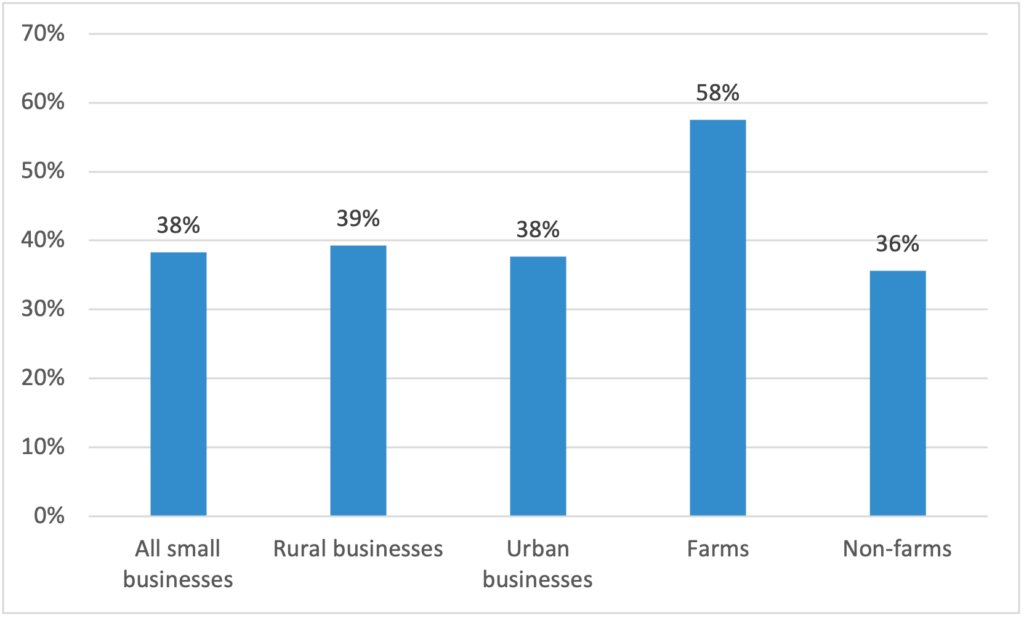
According to the NCR-Stat: Small Business Survey (Wiatt et al., 2024), roughly 38% of the sample of small businesses in the North Central Region (N=1,287) had an exit or succession plan. However, data varied based on further segregation by category (shown below in Figure 1). Roughly 39% of rural businesses and 38% of urban small businesses had an exit or succession plan. The largest difference was found between farms and non-farms, with roughly 58% of farms having a plan and only 36% of non-farms having an exit or succession plan. Perhaps this difference could be accounted for by the tendency to pass farms down from generation to generation and the knowledge that an asset-heavy business needs a succession plan to be tax-efficient and expedient in the transition of assets.
Figure 1. Percentage of North Central Region small businesses with an exit or succession plan
Source: NCR-Stat: Small Business Survey (Wiatt et al., 2024).
EXPLORING EXPECTATIONS AND DESIRES
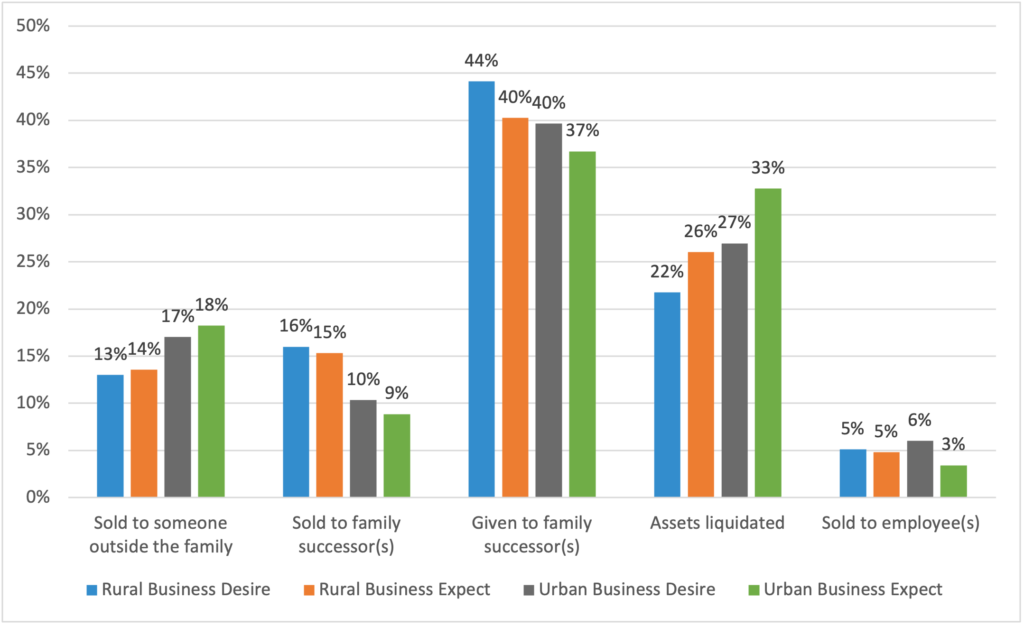
Succession planning is often discussed in the context of family farms, with many farmers ideally desiring to pass the farm to their children. Succession planning for small businesses may look different, with owners potentially seeking suitable successors outside their own families. Furthermore, expectations and desires may differ regarding what happens to the business after the owner exits. The NCR-Stat: Small Business dataset collected data on owners’ expectations versus desires. Results can be found below in Figure 2.
Figure 2. North Central Region rural and urban businesses expect vs. desire for transfer of business to the next generation
Source: NCR-Stat: Small Business Survey (Wiatt et al., 2024).
Figure 2 reveals a consistent and notable pattern across both rural and urban businesses in the region. Owners consistently desire family-centered transitions more than they expect to achieve them. Among rural businesses, 44% desire to give the business to family successors, yet only 40% expect this outcome to occur. A similar gap appears for urban businesses, where 40% desire a family gift transfer compared to only 37% who expect it. This gap between desire and expectation likely reflects the owners’ awareness of real-world barriers, such as a lack of interested or financially capable successors, family conflict, or structural challenges. Conversely, both rural and urban owners expect asset liquidation at higher rates than they desire (rural: 26% expect vs. 22% desire; urban: 33% expect vs. 27% desire), suggesting that for many owners, liquidation is an anticipated fallback rather than a preferred outcome. Rural and urban businesses are broadly similar in their succession expectations and desires, though urban businesses show a slightly higher tendency toward outside sales (18% expect) and liquidation (33% expect), which may reflect differences in asset transferability and family engagement in non-agricultural business contexts.
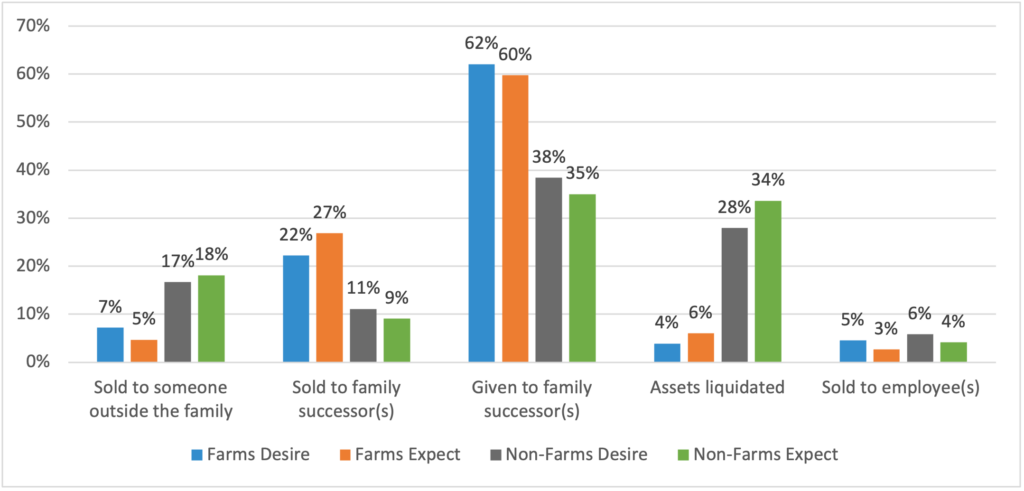
Figure 3. North Central Region farm and non-farm expect vs. desire for transfer of business to the next generation
Source: NCR-Stat: Small Business Survey (Wiatt et al., 2024).
Figure 3 highlights the most striking contrast in the dataset, which is the vast difference in succession intentions between farms and non-farm businesses in the North Central Region (rural and urban). Farm owners overwhelmingly desire to give the business to family successors (62% desire; 60% expect), a rate more than 1.5 times higher than non-farm businesses (38% desire; 35% expect). This finding reinforces the generational legacy and family-focused nature of farm succession. For many farm families, transferring land and operation to the next generation is not simply a business transaction but a deeply embedded cultural expectation. Notably, the alignment between desire and expectation is relatively strong for farms, suggesting that farm owners are more confident in their ability to achieve family transfer than their non-farm counterparts. In contrast, non-farm businesses show a much higher rate of anticipated asset liquidation (34% expect vs. 28% desire), underscoring the challenge many non-farm owners face in finding willing or qualified successors. Non-farm owners also show more variability in their exit pathways, with significant shares expecting outside sales (18%) and liquidation. The divide between farm and non-farm businesses is the most pronounced segmentation in the dataset, with significant implications for how extension educators and advisors approach succession planning conversations with different business types.
CONCLUSION
The data from the NCR-STAT: Small Business Dataset paint a clear picture of the region. Succession planning remains underprepared across the rural small business landscape, and gaps between owners’ desires and expectations reveal both the aspirations and the anxieties that accompany owner exit. Only about 38% of all small businesses have any exit or succession plan in place, a figure that should concern communities, policymakers, and advisors alike. Given that small businesses, especially rural ones, serve as far more than economic engines, their loss through unplanned closure carries massive community consequences.
Across all business types, the most desired exit pathway is giving the business to a family successor, yet owners consistently expect this outcome less than they desire it. This desire-expectation gap is a meaningful signal. It suggests that many owners are aware of the barriers standing between their hopes and reality — whether a lack of willing heirs, insufficient successor readiness, financial complexity, or simply the difficulty of having the necessary conversations. Meanwhile, asset liquidation is consistently expected at higher rates than desired, functioning as a default outcome rather than a chosen path. This is particularly sobering given the known economic and community ripple effects of small business closures.
The divide between farm and non-farm is the most pronounced finding in this analysis. Farms stand apart in their strong alignment between desire and expectation for family transfer, with approximately 60–62% of farm owners both desiring and expecting to give the business to family successors. This reflects the deeply cultural and intergenerational nature of farms, where passing the land and operation to the next generation is often a defining family value. Non-farm businesses, by contrast, show far more uncertainty and a much higher likelihood of anticipated liquidation, a pattern that underscores the need for targeted outreach and planning support for this larger, often-overlooked segment of the rural business community.
These findings carry practical implications for rural and community development. First, succession planning conversations must begin earlier; the gap between desire and expectation widens when planning is deferred. Second, programming should differentiate between farm and non-farm businesses; a one-size-fits-all approach fails to address the distinct motivations, barriers, and pathways each group faces. Third, the relatively high rates of anticipated liquidation for non-farm businesses suggest a need for succession readiness programming that equips owners to identify, develop, and communicate with potential successors (within the family or beyond it). The aspiration to pass a business to the next generation is alive and well across rural communities. What is often missing is a clear, supported pathway to make that aspiration a reality.
FUTURE RESEARCH
One area warranting further exploration is the role of heirs’ property in rural small business succession. Heirs’ property (informally inherited land passed down without clear legal title) is particularly prevalent in communities of color and among historically underserved rural populations. Owners of heirs’ property often lack the legal standing to access USDA programs, secure financing, or formally transfer the business, making the desire-expectation gap documented here even more acute for these owners. Future research should examine how heirs’ property ownership intersects with succession planning intentions and what targeted legal and Extension interventions might help these families resolve title issues before a transition becomes urgent.
REFERENCES
Wiatt, R. D., Marshall, M., Wilcox Jr., M. D., Bednarik, Z., Adams, N., & Katare, B. (2024). NCR-Stat: Small Business. doi:10.4231/6VG5-5386
Suggested citation
Wiatt, R. D. (2026, March). Small Business Owner Succession and Exit Intentions: North Central Region Analysis. North Central Regional Center for Rural Development. https://doi.org/10.22004/ag.econ.396377.