
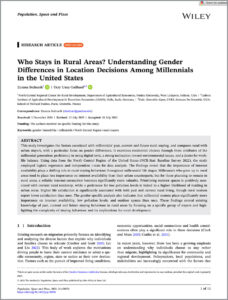
Who Stays in Rural Areas? Understanding Gender Differences in Location Decisions Among Millennials in the United States. https://doi.org/10.1002/psp.70076
While much of the research about rural migration of young people in the U.S. focuses on why this population leaves their rural residence, a new, open-access paper, recently published in the journal Population, Space and Place, shares the results of a study exploring factors that might contribute to rural millennials staying.
In this article, researchers Zuzana Bednarik, North Central Regional Center for Rural Development and İlkay Unay‐Gailhard, Leibniz Institute of Agricultural Development in Transition Economies share findings of their study which examined the factors associated with rural Midwest millennials’ past, current, and future decisions to stay in their residence, and compared rural with urban stayers, with a particular focus on gender.
Using the NCR-Stat: Baseline Survey 2022, which provides household data from the North Central Region of the United States, the study examined residential choices of millennials in the North Central Region through three attributes of the millennial generation: proficiency in using digital tools, a strong inclination toward environmental issues, and a desire for work-life balance.
“The decision to stay in rural communities is driven by multiple interconnected factors. As millennials now comprise the largest segment of the U.S. workforce, understanding which generational characteristics influence their choice to stay in rural areas has become increasingly important,” Bednarik said.
The study employed two statistical methods to assess the relationship between millennials’ characteristics and their likelihood of staying in rural areas over the course of their lives: logistic regression analysis and an independent t‐test.
The general findings related to past, current, and future rural staying reveal significant differences between rural stayers and their urban counterparts. Millennials who have remained in rural areas tend to prioritize internet availability, outdoor spaces, and environmental quality more than those who live in urban areas. Additionally, rural stayers report higher life satisfaction compared to urban dwellers, suggesting that those who choose to stay often find a greater sense of well‐being in rural areas. However, life satisfaction appears less influential in future location decisions, suggesting other factors may play a more significant role. Notable gender differences emerge in staying behavior, with women placing greater emphasis on the availability of the internet and environmental factors in their decision to stay in rural areas.
“The decision to stay in rural areas is a complex one. While our study’s findings align with existing research on migration and staying behavior, it offers new insights into the factors that might influence millennials’ decisions to stay in rural communities, particularly from a gendered perspective. Further research is essential to deepen our understanding of the various motivations behind both millennials’ and coming generations’ rural behavior,” Unay‐Gailhard said.
Access and download paper:
Bednarik, Z., and Unay‐Gailhard, İ. (2025). Who Stays in Rural Areas? Understanding Gender Differences in Location Decisions Among Millennials in the United States. Population, Space and Place: Volume 31 (Issue 6). https://doi.org/10.1002/psp.70076
# # #
The North Central Regional Center for Rural Development (NCRCRD) is one of four Regional Rural Development Centers in the United States. NCRCRD’s work links the research and educational outreach capacity of our region’s 34 land-grant universities with rural communities to help address a wide range of development issues unique to our 12-state region.
The Center’s work is supported by the USDA National Institute of Food and Agriculture. Any opinions, findings, conclusions, or recommendations expressed in this publication are those of the author(s) and should not be construed to represent any official USDA or U.S. Government determination or policy.