
By Renee D. Wiatt, North Central Regional Center for Rural Development
Workforce development challenges are reshaping rural businesses and the communities they serve. Small businesses are vital anchors in rural areas, providing not only essential products and services but also serving as community gathering places that foster connection and local vitality. This article examines workforce statistics for rural and urban small businesses in the North Central Region (NCR) using data from the NCR-Stat: Small Business Survey (Wiatt et al., 2024).
The Rural Small Business Landscape
Rural small businesses face distinct challenges compared to their urban counterparts. The COVID-19 pandemic intensified existing barriers including limited access to capital, inadequate broadband connectivity, scarce physical business spaces, a shallow labor pool, and a smaller customer base (Love & Powe, 2020; Woods, 2023). While support organizations such as Main Street programs, chambers of commerce, and small business development centers exist in rural counties, their services often fall short of addressing the fundamental capital and infrastructure limitations facing these businesses.
Understanding Business Size and Employment
The Small Business Administration defines small businesses as those employing fewer than 500 workers (Wilmoth, 2023). However, most small businesses are far smaller than this threshold suggests. Approximately 65% of rural businesses and just over 50% of urban businesses employ between one and ten people (see Figure 1). Only about 2% of rural businesses and 6% of urban businesses have more than 100 employees. These limited employee counts may reflect both business size and, critically, workforce availability constraints that small businesses face.
Figure 1. Number of Employees by Rural and Urban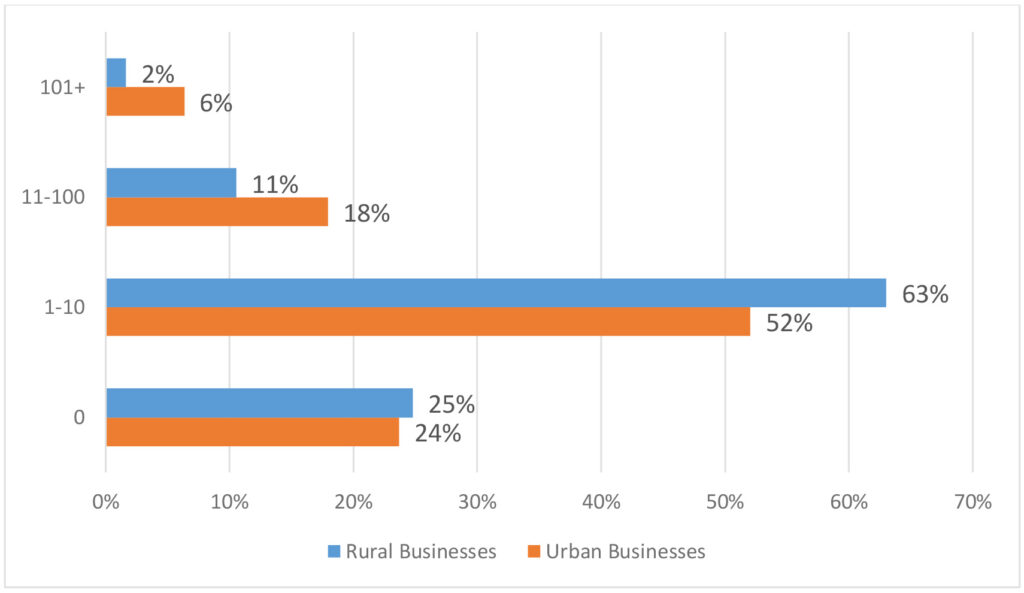
Staffing Shortages and Their Impact
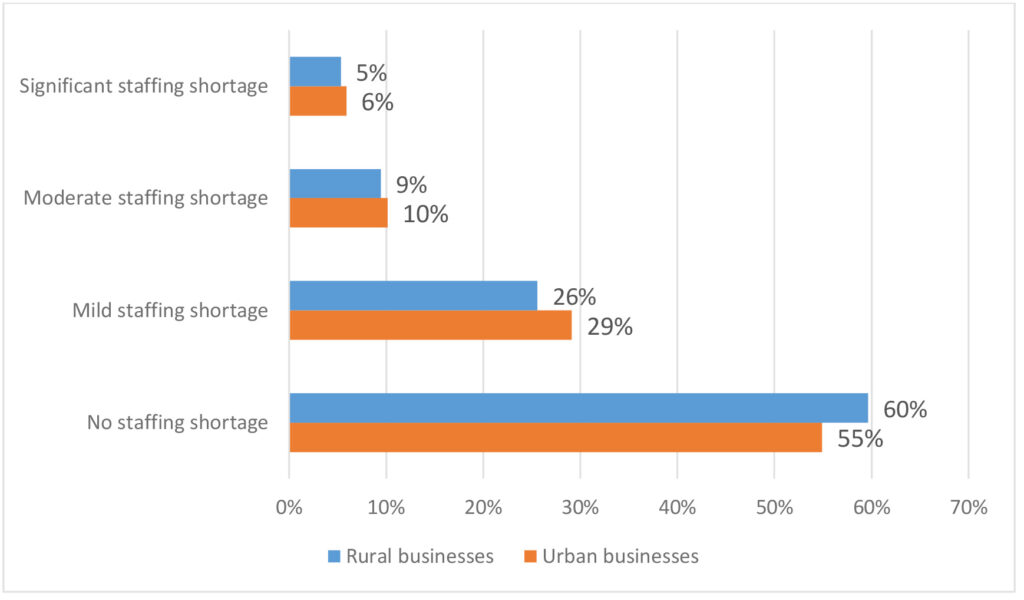
When employer businesses were surveyed about staffing levels, rural and urban businesses reported similar patterns. More than half of both rural (60%) and urban (55%) businesses indicated they experienced no staffing shortages (see Figure 2). However, a higher proportion of urban businesses reported mild to significant staffing shortages compared to rural businesses.
Figure 2. Severity of Staffing Shortage by Rural and Urban
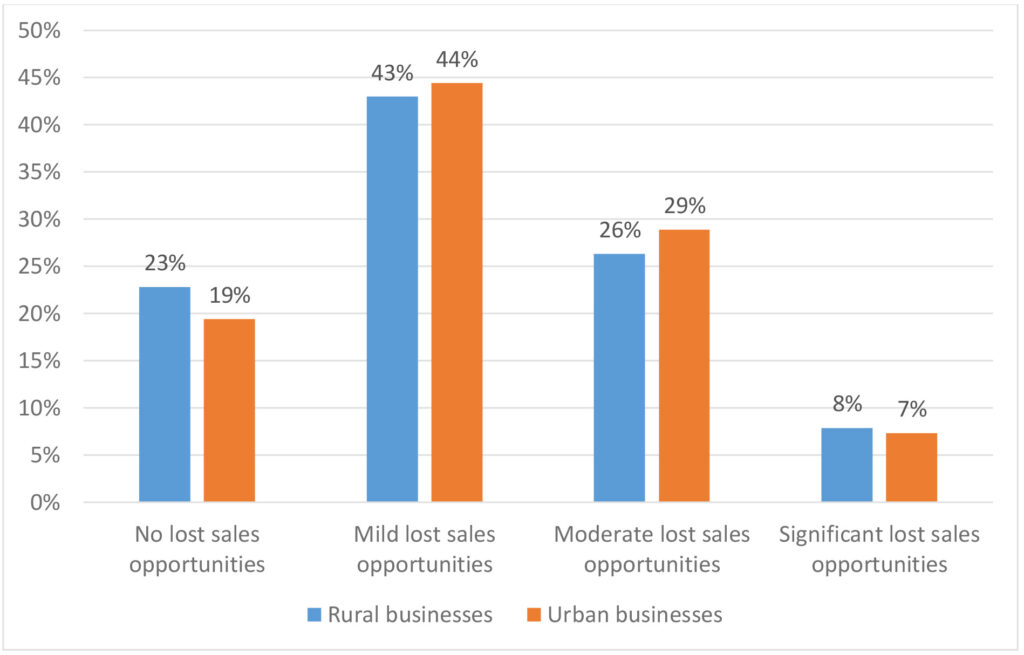
For businesses experiencing staffing shortages, the consequences are significant. The NCR-Stat: Small Business survey revealed that staffing gaps led to lost sales opportunities in most cases. As shown in Figure 3, only 23% of rural businesses and 19% of urban businesses reported no lost sales due to staffing issues. Roughly 43% to 44% of both rural and urban businesses reported mild lost sales opportunities directly attributable to staffing shortages, demonstrating that workforce challenges affect business performance across geographic contexts.
Figure 3. Lost Sales Opportunities Linked to Staffing Shortages
Barriers to Recruiting and Retaining Employees
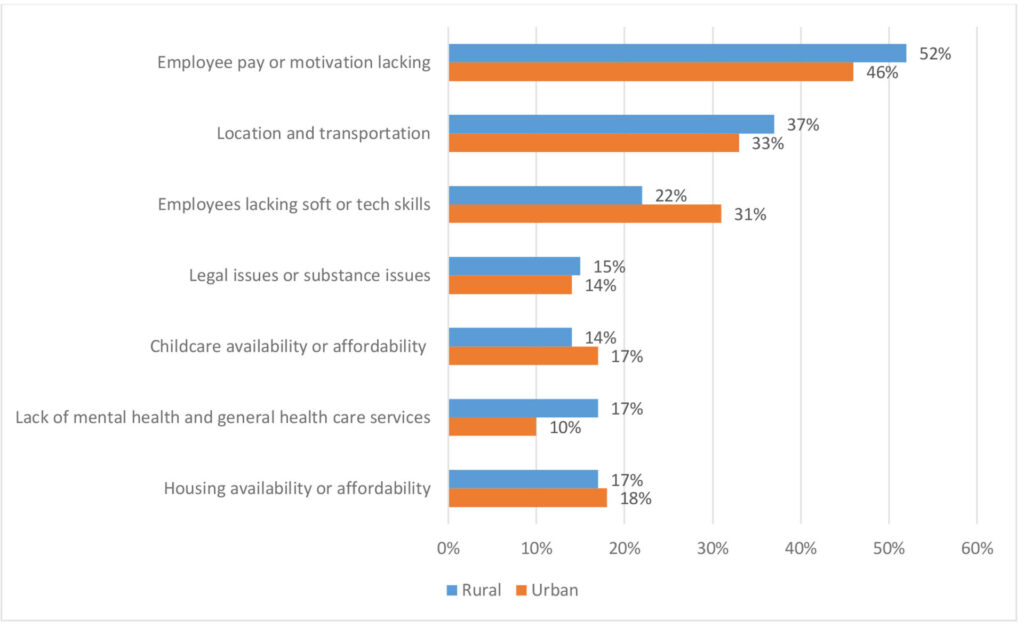
Small business owners identified numerous obstacles to recruiting and retaining qualified employees. While some challenges are internal to the business (such as insufficient wages), many stem from external factors beyond business control. See Figure 4 below for more in-depth statistics related to recruitment and retention.
The most frequently cited recruitment and retention challenge was linked to finances and motivation of employees: businesses unable to offer competitive pay (or unable to fund employees at all), or employees lacking motivation to work. Approximately 46% of urban and 52% of rural small business owners reported that low motivation or inadequate compensation limited their potential employee pool. Between 14% and 15% of business owners also cited employee legal issues (criminal history or other legal problems) or substance abuse concerns (inability to pass drug testing) as limiting factors.
Community infrastructure and amenities emerged as significant factors affecting workforce availability. About one-third of urban business owners and 37% of rural business owners identified business location and transportation access as recruitment and retention barriers. Urban small businesses were more likely to report employees lacking soft skills or technical skills (31%) compared to rural businesses (22%). Childcare availability and affordability, along with housing availability and affordability, also influenced employers’ ability to attract and retain workers.
Healthcare access presented a more pronounced challenge for rural businesses. While 10% of urban businesses cited limited mental health and general healthcare facilities as contributing to staffing problems, 17% of rural businesses reported that inadequate healthcare access affected their workforce stability (see Figure 4).
Figure 4. Issues in Recruiting and Retaining Employees
Employee Benefits and Compensation
Limited benefit availability may further constrain small businesses’ competitiveness in the labor market. Health insurance, paid time off, retirement plans, and other benefits can be prohibitively expensive for both employers and employees in small business settings (United States Department of Labor, 2018).
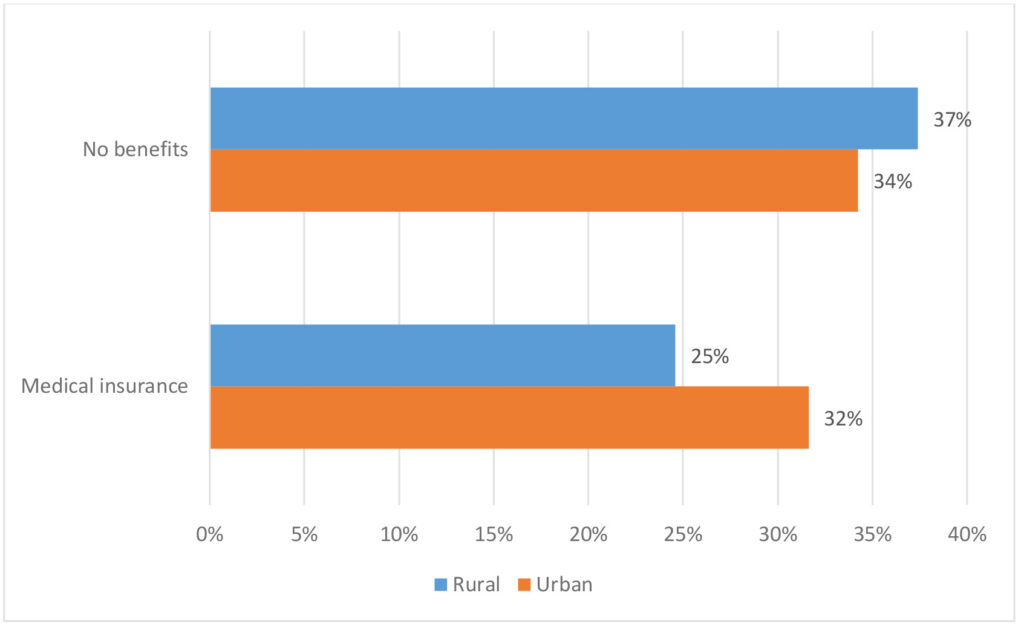
According to NCR-Stat: Small Business data, approximately 9% of rural and 15% of urban small businesses are nonemployers. Among the small businesses with employees, roughly 37% of rural small businesses and 34% of urban small businesses offer no benefits whatsoever. Only one-quarter of rural small businesses and 32% of urban small businesses provide medical insurance in combination with other benefits (see Figure 5). These limited benefit packages may place small businesses at a disadvantage when competing for workers against larger employers offering more comprehensive compensation.
Figure 5. Benefit Offerings by Rural and Urban Small Business
Conclusion
Small businesses remain essential contributors to the U.S. economy and vital anchors within their communities, particularly in rural areas where they often serve as central gathering places and primary employers. The workforce challenges documented in this analysis reveal that both rural and urban small businesses face significant staffing obstacles, though the nature and severity of these challenges differ across geographic contexts.
Rural businesses confront unique barriers including limited healthcare access, transportation constraints, and a more restricted labor pool. These structural disadvantages are compounded by difficulties offering competitive wages and comprehensive benefits. Urban businesses, while facing their own staffing shortages, have different challenges including higher proportions of employees lacking technical and soft skills. However, the common thread connecting both contexts is clear: workforce availability and quality directly impact business viability and growth potential.
The consequences of unresolved workforce challenges extend beyond individual businesses. Lost sales opportunities, reduced service quality, and business closures erode community vitality and economic resilience. For rural communities especially, where small businesses are often the primary employers and social gathering spaces, these losses are particularly acute.
As small businesses navigate an increasingly competitive labor market, their continued relevance and ability to transition successfully to the next generation will depend on comprehensive solutions that address both business-level challenges and the broader community infrastructure that shapes workforce availability. Ensuring small business vitality is not simply an economic imperative — it is essential for maintaining the social fabric and character of communities throughout the North Central Region.
References
Love, H., & Powe, M. (2020, December 1). Rural small businesses need local solutions to survive. Brookings. https://www.brookings.edu/articles/rural-small-businesses-need-local-solutions-to-survive/
United States Department of Labor. (2018, May 4). The benefits of working for a small business. TED: The Economics Daily. https://www.bls.gov/opub/ted/2018/the-benefits-of-working-for-a-small-business.htm
Wiatt, R. D., Marshall, M., Wilcox, M. D. J., Bednarik, Z., Adams, N., & Katare, B. (2024). NCR-Stat: Small Business. doi:10.4231/6VG5-5386
Wilmoth, D. (2023, August 22). Small business facts: Small businesses in rural areas. U.S. Small Business Administration, Office of Advocacy. Leppert, R. (2024, Apr 22). A look at small businesses in the U.S. Pew Research Center. https://www.pewresearch.org/short-reads/2024/04/22/a-look-at-small-businesses-in-the-us/.
Woods, C. (2023, April 26). Identifying the top threats to rural small businesses, and what Main Street is doing to mitigate issues. Emporia Main Street. https://emporiamainstreet.com/identifying-the-top-threats-to-rural-small-businesses-and-what-main-street-is-doing-to-mitigate-issues/
Suggested Citation
Wiatt, R. D. (2025). Rural Small Businesses in the North Central Region: Workforce Development. North Central Regional Center for Rural Development. https://doi.org/10.22004/ag.econ.383710.